Showing posts with label cycle tracks. Show all posts

Wednesday, 6 November 2013

Look beyond the surface...

Look at this photo. What do you see? I see a young girl smiling. I think to myself, she seems really happy. Maybe because it's summertime, or maybe it's because she has an awesome red bike. Perhaps she's excited because this is the first time she's ridden her bike without her parents holding on, or that she knows she's really close to getting rid of her training wheels. All I know is that she looks happy, and that's what matters.

Now look closer. Read deeper into this photo. See the young girl, around age six, who is well on her way to enjoying riding a bike for years to come. If she continues riding her bike often enough, she will be healthy and active, helping to keep illnesses related to inactivity away. I also see confidence, which will help her as she starts to navigate around the city she lives in, knowing she is capable of mapping out her path, finding the best route, and if she gets lost, she will calmly be able to figure out where to go next. I also see the parents behind the camera that are helping to nurture her and support her. Otherwise, this photo wouldn't even exist. 

One thing I don't notice, or at least I shouldn't care to notice, is that she isn't wearing anything protective. No helmet, no pads or armour. Just a girl riding her bike. Why isn't she wearing those things? Her parents must not feel that what she is doing is unsafe, and therefore doesn't require a ton of safety gear. They simply think that they learned to ride a bike when they were kids, and want to share this knowledge and experience with their own child. And they should be congratulated like any other parent for starting their kid on the right path to a happy and healthy childhood.

The sad truth is, though, that many people will look at this photo and get angry. They won't see the joy, the possibilities and the positivity about this young girl on a bike. They will simply see a child without a helmet and think that her parents are awful, irresponsible people, putting their child in danger by allowing her to do a perceived dangerous activity without protection. These people would rather see this girl travelling safely in a car, or not leaving the house at all, safe on her couch, than accept that the dangers of riding a bike are not as extreme as they have been made out here in North America.

Just last week, the Canadian Paediatrics Society called for legislation to mandate helmet use for all ages across Canada. The concern is for a reduction of concussions and other head injuries, most specifically amongst the young. Studies were discussed, saying that bicycle related injuries account for four per cent of emergency department cases. Sure, that's relevant, but how many of those were related to actual helmet usage. What I'm hearing is four out of one hundred child and youth emergency department cases are bike related. Let's face facts here. Overall, that is a really low percentage, which translates to me that riding a bike is really not that dangerous, even for the young.

Part of the reasoning for the recommendation, Paediatricians in the society say, is that in areas where there is mandatory helmet legislation, helmet usage is up. Well, of course it is. If you want to ride a bike but don't want to run the risk of being fined, do you really have a choice? The study I want to see is whether or not cycling rates in those areas also decreased as a result of the legislation. In Australia, where a mandatory helmet law has been in place longer than here in BC, this is what studies have found:

"As reported in March 2007 and based on data from Western Australia, Queensland and Victoria, the number of Australian children walking or riding a bicycle to school has plunged from about 80% in 1977 to the current level around 5%. The data confirms that in Western Australia, the decline of cycling began around 1991 when the helmet law was enacted." (Source)

What has been increasing in Australia are cases of childhood obesity, the rates of which tripled between 1985 and 1995. A survey from 2008 reported that one in four children aged 5-17 were overweight or obese. So while children may be safer while riding their bikes due to helmet usage, the helmet law has essentially detracted children and youth from riding, therefore increasingly their inactivity and risking their health. Surely the focus every where should be more on keeping kids active and healthy in their every day lives, instead of putting restrictions on the fun and easy ways they can do that. And if safety is such an important concern, which I don't disagree with, then padding our kids up with body armour isn't the answer. Instead, cities should be focused on creating better, safer infrastructure for all cyclists. Traffic calming, separated lanes and driver education will go much further to keep us and our children safe and get more people active and on a path to overall health and wellness.

This photo was taken nearly three decades ago, and if you haven't guessed by now, the girl in that photo is yours truly. I have been avidly riding my bicycle now for over 30 years. From riding around my neighbourhood as a kid with my friends, to the other side of my suburban home town to meet up with my teenage boyfriend, to today, riding with that same boy, now my husband, and my own children, I have never once thought what I was doing was too dangerous. I don't take risks while I'm on my bike, I refuse to "ride with the bulls", preferring to stay on quieter roads or streets where I am separated from the cars. But most importantly, I am still that young girl in the photo, simply on a bike, smiling and having fun, and that's what should matter most.

Monday, 29 July 2013

Living the bike share dream in Montreal

Two weekends ago, I had the incredible privilege of returning to a city where I spent much of my childhood, and experiencing it in a whole new light. My parents grew up in Montreal, and as such, nearly all of my extended family continue to live there. Meaning while growing up in Ontario, I spent many weekends and extended vacations visiting La Belle Province. This time around, with our kids enjoying cottage life with my parents in the Laurentians, Chris and I enjoyed two wonderful days exploring Montreal as tourists, on our favourite means of transportation... the simple bicycle.
Picking up our first set of bikes for the weekend
Cruising along the separated lanes of Montreal's Le Plateau area
Thanks to Chris being part of the Cycle Chic Republic, we were able to connect with Anne of Montreal Cycle Chic, who set us up with two complimentary BIXI keys for the weekend. How absolutely wonderful to be able to experience a bike share system that has been growing and thriving for five years. Being big proponents of the impending Vancouver bike share system, we were in heaven: being able to easily check out an upright bike, ride to our destination, then simply dock the bikes and move on with our day. We knew we would love the bike share system, and Montreal's BIXI did not disappoint. 
Hanging out on Sunday with our new friend from Montreal Cycle Chic
A handsome self-portrait
What I found most amazing, though, is how many Montrealers we witnessed using the bike share at any given moment. All throughout the street were people of all ages using BIXIs to get around their beautiful city. We had even heard stories from our friend how they know people in the city who sold their personal bikes and rely exclusively on the bike share to get around. It was easy to see why: BIXI Montreal offers 400 stations throughout the city and 5,000 bikes, meaning that you are never far from a station and a bike to get you where you want to go.
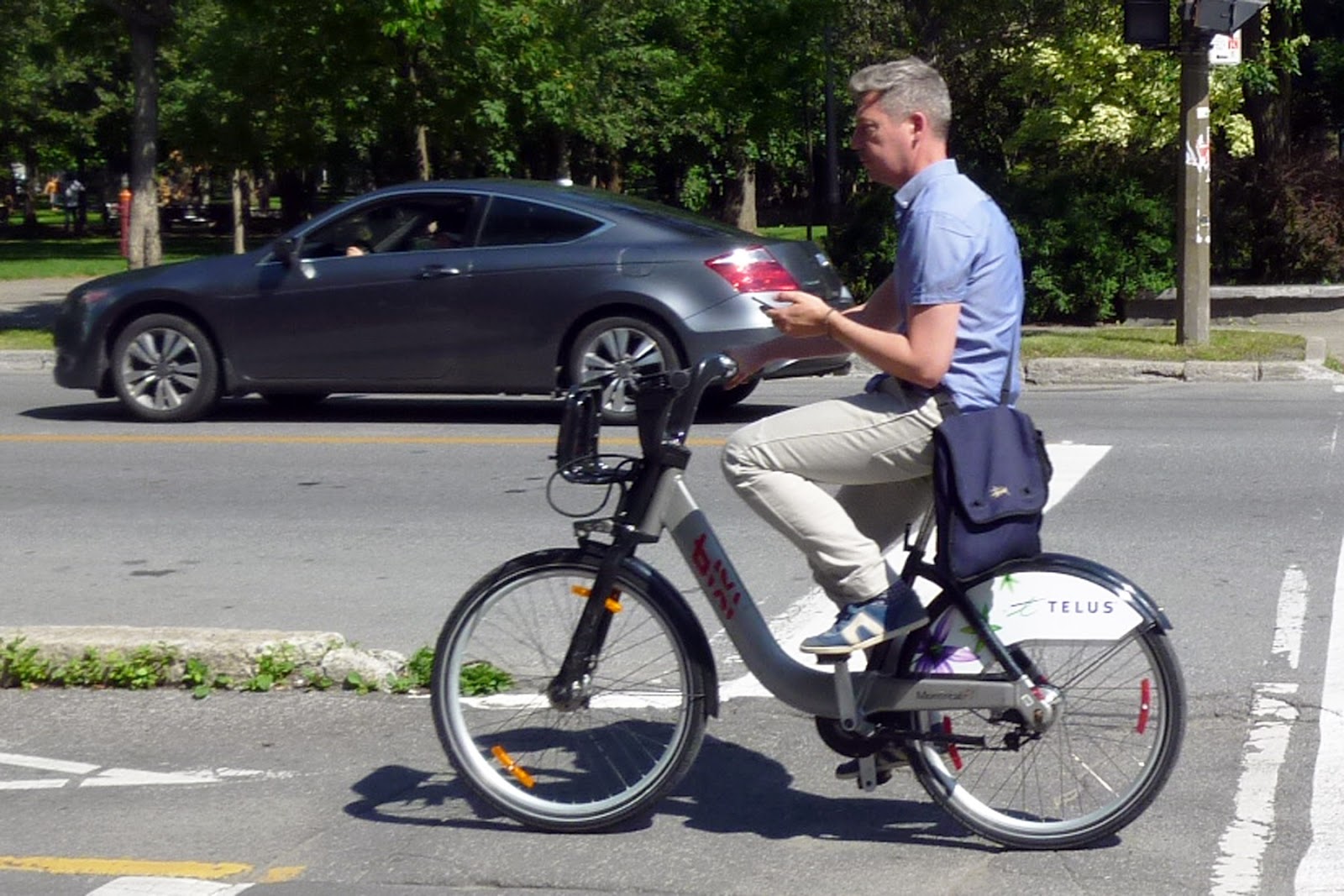
This dapper fellow looked very cool on a Bixi
Barely tall enough to ride but enjoying it nonetheless
Experiencing Montreal on a bike was a dream, especially having spent so many visits using the Metro to get around underground. I travelled to many new and familiar places on two wheels, seeing one of my favourite Canadian cities up close and personal. The bike share was just an added bonus. It made me so hopeful for what Vancouver's bike share could become. For now, I feel lucky to have had the experience I did riding around the streets of Montreal the way locals do, on a BIXI bike, in the sunshine, with a smile on my face!
Riding a Bixi - there's nothing to it!
Outside Club Social on Rue St Viateur -
a certain M. Coville-Andersen's favourite viewing spot in Montreal
One last shot before ending a perfect weekend in Montreal

Sunday, 21 July 2013

A Familiar City Seen Through New Eyes - Toronto, ON

All set for my two days of bike riding
in Toronto!
The Velo Family is currently on holidays, enjoying some quality time with our families in Ontario. It had been wonderful catching up, starting with relaxing on Lake Ontario with my in-laws, and now spending some quality time with my parents at their lake front cottage in the Quebec Laurentians. Every trip back East is special, since our children don't get to see their grandparents, aunt and uncles very often due to the distance and the expense of travel. For my husband and I, however, this trip was extra special for two reasons. We would finally be able to enjoy an extended amount of kid-free time, and we would be doing so in two cities full of memories for us - Toronto and Montreal.

As the opening leg of our trip had us just a short jaunt away from Toronto, that is where we spent our first mini-holiday without our children. Chris and I spent four amazing years in this city while studying at Ryerson University. In that time, however, we were never able to completely appreciate the city and the bike culture it had to offer. Believe it or not, we actually didn't ride all that often, what with Chris not owning a bike and mine sitting comfortably at my parents' home the first three years of school. We tended to stay within our school bubble, as most students do, and my limited experience in the city on my bike didn't leave a very lasting impression.

So when we arrived in Toronto last Saturday, we headed over to rent some bikes from a shop called Set Me Free on Roncesvalles (I still can't pronounce that properly) and experience what the city had to offer two bicyclists from the West Coast. At the shop, we were told they had many a mountain bikes to rent. Instantly, my heart sank. Mountain bikes? In Toronto, a city known for it's vintage bike culture? After some puppy dog eyes, and pointing out I was in a skirt, the guys at the shop had a peak in their older stock and found not one but two beach cruisers! Luck was on our side, and I was grateful. We spent the next two days riding from West to East and back again, taking in the city we had known with a fresh set of eyes and ideals while cruising around at a slow pace.
Chris cruising through Cabbagetown, keeping cool in
extreme the heat with some bare arms!
What we found was actually surprising! In a city currently notorious for being less than bike friendly, at least if you follow the politics, bike culture was thriving. Every where you looked there were people on bikes. On Queen West, there were, of course, the fashionable twenty and thirty somethings riding their upright city bikes, but what amazed us was the sheer number of them. So many that at any time you could see three or more cyclists waiting together at a red light. That many not seem like many, but this was literally happening all day long, not just rush hour, and on a Saturday and Sunday. Outside of the trendy areas, we were surprised and in awe to find riders of all ages hoping on bikes to ride in their city. 
A typical site along Queen West
The biggest eye-opener happened when walking to brunch on Sunday. We saw a man, likely in his mid-to-late sixties, walk out in a nice shirt and pants, hop on his bike, and head to what we can only assume was his weekly Church service (we were in Little Italy, so the assumption seemed fair). In all my six years in Vancouver, I don't think I have ever once seen a sight like that, and with two small children who seem to not sleep past 8:00am, you can bet I've been out and about our city around Church time on a Sunday morning.
Riders of any age were out and about the city on their
bikes, no special equipment needed.
I loved riding through Toronto and seeing so much I had missed during my university years. But I think what has stuck with me most is that even in a city where cyclists are fighting for their own space on the road, rubbing shoulder with cars, trucks, and fast moving steetcars, in face of all this adversity, their bike culture is big and strong. I'm sure every one of those people would love to have the separated lanes we have in Vancouver and for which I am so grateful, but not having them doesn't stop them from riding a bike. It makes me wonder...if Toronto's next city government is as pro-active for bike infrastructure as Vancouver's is, could Toronto become the North American Copenhagen? For all the wonderful bike riders we met last weekend, I will keep my fingers crossed, because they deserve it!
Bike traffic!
One of the many sadly underused Bixi stations.
Don't worry, there's hope to be found in other Canadian cities. Stay tuned to find out!
Just taking a couple of dogs for a walk in Trinity Bellwoods Park
One of our lovely hosts for the day Sunday, Yvonne, with Bonnie the dog
taking in all the sights from the comfort of her basket!
Riding along on of the only cycle tracks in Toronto along Sherbourne Street
I don't know if it's there yet, but with this kind of attitude
and bikes abound, it could be!

Tuesday, 18 June 2013

VancityBuzz Guest Post: The Human Side of Vancouver Bike Lanes

Last week I was pointed in the direction of an online post on VancityBuzz.com featuring an image of my daughter and I on the Hornby protected bike lane. Intrigued, I read through the piece and found it to be a very critical summary of the proposed installation and upgrades to the current protected lanes. Overall, the piece had an air about it that made protected bike lanes out to be an unnecessary expense. Not only was I disappointed with the tone of the piece, but I was also unimpressed that an image of my family happily using the protected lanes was attached to it (the image has since been removed). After some exchanges between myself and my husband on twitter, the editor of VancityBuzz asked me to write a rebuttal. The following is that rebuttal, which I hope brings to light how important protected lanes are to all road users, motorists, pedestrians and cyclists alike, and especially to families like mine!


Vancouver Canada News Opinion: The human side of Vancouver bike lanes
JUNE 18, 2013
Posted by  | Speak Up
Frequently, when you read about the introduction or improvement of bike lanes in Vancouver, you get the impression that the city is out of step with the rest of the world, given the resistance they receive from business owners, motorists, and news organizations. The simple fact remains, that despite being a city that prides itself as being “bike-friendly”, it is lagging behind so many other North American cities. The City of Chicago, for example, committed to increasing the number of bicycles on their streets, has already laid 17 kilometres of protected lanes of  160 kilometres planned to be installed by 2015. Vancouver currently sits at six kilometres of protected lanes, and faces stubborn opposition every single time they suggest adding more.

I’m quite happy with the existing, functional cycling network found in Vancouver, and I’m reminded of that whenever I visit the many other places that still refuse to acknowledge the existence of the bicycle. However, I am continually perplexed at how angry people get about proposals to either introduce new facilities, or upgrade existing ones. From the perceived increase in congestion, to the loss of parking spaces, and the money being spent to install them, it’s quite amazing how such a small step forward for our city can get many people into such a rage.

What I think the general public doesn’t realize is that throughout North America, many cities are seeing the collective benefits of installing physically separated bicycle lanes. The biggest benefit, especially to a mother like me, who travels by bike every day with two small children, is that protected bike lanes increase the safety of myself and my family. Since the introduction of the two-way cycle tracks on Hornby and Dunsmuir Streets, there has been a 20 per cent reduction in collision between vehicles, cyclists and pedestrians. In a city with a population of just over 600,000 people, not including tourists and those travelling into the city daily from the suburbs, that’s a pretty important decrease, and in just one tiny stretch of the downtown peninsula.

For the average person who doesn’t ride a bike daily, the idea of pulling that rusty frame out of storage and pedalling through the city can appear difficult, dangerous and uncomfortable. Rubbing shoulders with cars, and feeling the need to keep up with their two-tonne metal counterparts to avoid agitating impatient motorists, would only sound exciting to someone who likes to live dangerously. The fact is that if given the right infrastructure, riding a bike is easy, safe, and incredibly enjoyable. Providing better infrastructure will get “bike-curious” citizens all of sizes, incomes, and ages to give riding a bike a shot, whether they’re kids, millenials, or boomers.

As any motorists can attest, driving behind or next to a cyclist is just as nerve-wracking for the person in the car. One wrong move and anything could happen. While turning right from Hornby to Georgia Street may be painfully slow during peak hours, as priority is given to the bicycles and pedestrians, drivers can now rest a bit easier knowing that they no longer have to worry about someone suddenly appearing out of their blind spot, ending in a collision. Protected bike lanes make car/bicycle/pedestrian travel much more predictable, reducing collisions, and keeping more people out of emergency rooms. That can’t possibly be a bad thing.

The simple fact is that bicycle travel is increasing in the City of Vancouver. It is not a “war on cars” as has been lazily and sensationally proposed by the media, but rather a council and their citizens moving forward and embracing changing times. Physically separated lanes have played a part in that, with cycling being the fastest growing transportation mode, experiencing a 40 per cent increase in the number of trips between 2008 and 2011. More and more people are opting to get on a bike because it is getting safer and easier. Increased options means less people in cars, which in turn means reduced congestion on our streets.

Another significant sign that protected bike lanes are a good thing is the simple fact that among the increased number of cyclists on the road, the number of girls and women choosing to ride has had the biggest growth. In 2011, 41 per cent of all trips made by bicycle were done by girls or women, 11 per cent higher than the 2006 Canada Census average. It has been well documented that women are the indicator species, meaning that until women adopt an idea, in this case using a bicycle as a safe and reliable means of transport, it will not have resounding success. So, in Vancouver, where nearly half of those choosing to ride a bike are women, it is pretty clear that through introducing protected bikes lanes the city has made cycling safer for all riders, regardless of age, gender and ability.

The three proposed bike lane improvements will cost Vancouver taxpayers approximately $3 million, equating to about $5 per resident. Meanwhile, the recent provincial transportation budget plans for $179 million in road rehabilitation expenses alone in 2013/14 , while cycling projects account for just $3 million in the same period of time. So it’s important to have a bit of perspective when it comes to the cost of embracing these vital safety upgrades to existing infrastructure. The bottom line is this: protected bike lanes are the future of transportation, and if we keep having these ridiculous bike vs. car debates, Vancouver is going to be left in the past.

Written by Melissa Bruntlett.
Melissa Bruntlett lives in Vancouver with her husband and two young children. When not riding around with her family and enjoying life by the ocean, she writes for her blog Velo Family Diaries, where she talks about the triumphs and challenges of a car free existence. Find Melissa on Twitter at @VeloFamilyYVR.
Image: Chris Bruntlett @cbruntlett

Monday, 24 September 2012

Separation anxiety

Back in July I wrote about how great an idea separated lanes are and that the City of Vancouver should work to expand the network of such lanes in the city, including in my own neighbourhood of Commercial Drive. To my surprise and delight, I have started seeing more and more articles about separated lanes in my city, including along the Cambie and Granville Street Bridges.

However, much to my dismay, there is still so much aversion to them by various city officials and business owners and some of the general public. Rhetoric about bike lanes being "anti-car" is being thrown around in local publications, and one member of the Downtown Business Association states that separated lanes may "choke the lifeblood out of downtown". Is this really the view of population of Vancouver, or the voices of just a small few? I looked up some facts about separated lanes and their benefits, and wanted to share them with you. Maybe if we start looking at the long term benefits, we can stop arguing about separated lanes are start emulating some truly innovative cycling cities that aren't afraid to make some real change to their infrastructure.

In New York City, The Department of Transportation built a bicycle path and traffic calming pilot project for Prospect Park West in Brooklyn in 2010 and published their results in early 2011. The path was 2-way and separated from traffic lanes by a 3 foot parking lane, and meant the removal of just one lane of traffic. Here's what they found:
  • weekday cycling traffic tripled after the implementation
  • cyclists riding on sidewalks fell to 3% from 46%
  • speeding dropped from 74% to 20% of all vehicles 
  • crashes for all road users were down 16% and injuries to all road users were down 21%
  • the was no change in traffic flow or travel times
A study was conducted in Montreal in 2010 that compared the amount of cyclists using separated cycle tracks vs regular road traffic without any dedicated cycling infrastructure. The streets ran parallel to each other and had similar intersection and cross traffic frequency. Again, the results are pretty convincing:
  • 2.5 times as many people used the separated cycle track than the road without dedicated infrastructure
  • the relative risk of injury on the cycle track was lower than cycling on the street
Here in Vancouver, while our adoption of separated cycle tracks has been met with diversion each time, their results have always shown a positive increase in cycle traffic.
  • Trips over the Burrard Bridge increased 15% between July 2010 and July 2011, and saw over 1 Million trips taken in that time
  • Between 1996-2011, there has been a 25% decrease in the number of vehicles entering downtown, but an increase of 10% of people entering downtown (during peak hours)
  • In June 2011, there were 55,000 recorded trips along Dunsmuir
  • Total trips on Hornby grew from 60% of Dunsmuir levels in January 2011 to 80% as many in June 2011
  • Women riders were up slightly versus the previous painted lanes, making up 1 in 3 cyclists on Hornby in 2011
  • Children were now four times more prevalent in stats collection in 2011
My own personal reflection:
You know my story. I'm a mom with two young children, living without a car in Vancouver. We try to use our bikes whenever possible to get around the city, and use they cycling infrastructure in this city to do it. My eldest is 6 and travels on her own bike now, which means I am very conscious of being sure the areas we ride in are safe, with as little risk as possible of us coming into close contact with fast moving cars. So when we are heading into downtown, we make a point of using the separated lanes on Dunsmuir and Hornby. Before the completion of Hornby separated lane, I used the painted lane only once with the kids in tow, and refused to do it again until the cycle track was built. Having cars race past at high speeds and risking running across a vehicle parked in the lane made it incredibly nerve-wracking and dangerous. Now that the path is separated, I have no qualms about using them with my kids.
My youngest trailing behind with a green
buffer from the cars

My eldest on the Dunsmuir Viaduct
It's time we stopped fighting about bike lanes. It's a waste of time, especially for a city that wants to be the Greenest City in the World by 2020. If we don't provide the average person with a safe means to travel by bike, they just won't. Separated lanes also make trips more pleasurable for pedestrians, creating a barrier between them and the cars. My husband, Chris, actually commented last week that his walk home with the kids the 3 blocks along Commercial Drive was unpleasant with all the cars and exhaust during rush hour. Something as simple as a separated lane would have made that journey even slightly better, and who can really argue with that?

Some final words on the topic from Brent Toderian, the City's Planning Director for 6 years and now and independent planning consultant, “Bike lanes are not a fad. They are part of a multi-modal city, a critical part of the city working well in the future.” Well said.

Sources:

Some other articles to check out:
http://www.theglobeandmail.com/news/british-columbia/stop-bike-lane-fight-vancouver-urged/article4558182/
http://www.theglobeandmail.com/commentary/editorials/separated-bike-lanes-are-the-way-to-go/article4431730/
http://spacingvancouver.ca/2011/09/26/vancouvers-separated-bike-lanes-more-popular-than-ever/
http://www.cbc.ca/news/canada/british-columbia/story/2012/09/23/bc-bike-use-vancouver.html